How E-Commerce module fits with Classic Salesware
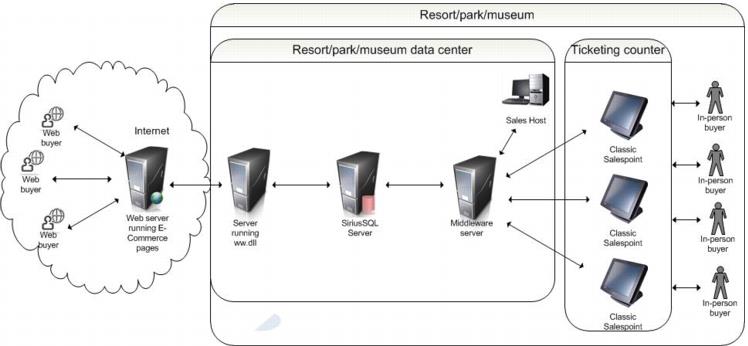
The following diagram shows how E-Commerce module is configured to work with Classic Salesware. (Classic Salesware is Siriusware’s flagship product, whereby resorts, parks and museums deploy Salesware within a physical resort to sell tickets, passes, gift cards, retail items, rental items and so on, to in-person visitors.)
The Salesware E-Commerce pages, shown running on the web server on the left side of the figure, constitute the core component of Salesware E-Commerce and are released twice a year with the latest features required by Siriusware Inc. E-Commerce clients. The Salesware E-Commerce pages are used to create the client web sites. However, a small number of clients choose to write their own E-Commerce pages. To do this, clients use in-house or hired programmers to write programs that interface with the Salesware ww.dll Application Programming Interface (API) in the same way that Siriusware Inc. E-Commerce programmers program using the ww.dll “layer” to produce the Salesware E-Commerce pages. This “layer” is also updated twice a year (ww.dll is released twice a year) to provide ever-increasing functionality (expanded and new APIs) used by both Siriusware Inc. Programmers and Siriusware Inc. clients who develop their own E-Commerce pages.
Note: It is important to distinguish between clients who write their own E-Commerce pages that interface with the ww.dll layer and clients who simply customize the standard Salesware E-Commerce pages that Siriusware Inc. releases twice a year (also referred to as the “default” pages). Nearly all clients perform some customizations to the “default” pages (add special graphics, customize wording, etc.), while a relatively small number of clients develop their own pages “from scratch” that make “calls” to the ww.dll API.
The Sales Host computer is simply another salespoint, just like a regular salespoint that you find at a ticketing counter, but it is used exclusively to process Salesware E-Commerce activity, so does not require a human operator. Sales Host performs its functions as a salespoint by rapidly “polling” the SiriusSQL database (polling speed is configurable with an .INI setting) to discover E-Commerce activity as this activity occurs. You can even have multiple Sales Hosts if you have a very busy web site. As soon as a web visitor/guest performs some action on the client web site (buys a ticket, reserves a rental item, etc.), Sales Host sees the action and responds appropriately (charges the guest credit card, e-mails the guest a confirmation, etc.). Sales Host operation is described in detail in Appendix A: Detailed description of Sales Host operation.
From a software “layering” point of view, Salesware E-Commerce module is implemented using the following software “stack.” There are clear software interfaces between each component in this stack.
Salesware E-Commerce web pages (or client-developed web pages) |
ww.dll API (see the Salesware ww.dll API Reference for a complete description of this layer) |
SiriusSQL database |
Middleware (SalesEZ, BookEZ, etc.) |
Sales Host “salespoint” |
The modular nature of the Salesware E-Commerce and Classic components allows each component to be placed on a separate computer, or all components (except for the individual salespoints requiring separate physical operators) can be installed on the same computer. However, Siriusware Inc. does not recommend installing all components on the same computer, primarily for security reasons, but this configuration is possible.
The reason you can install more than one Salesware component on a computer is because of a feature of Windows operating systems called ports. Computer applications like ww.dll, SQL Server, SalesEZ and so on can communicate with one another using ports. If two applications are on the same computer, they can communicate using two different ports on the same computer. If two applications are on different computers, they can communicate using ports on different computers.